

Formic acid and acetic acid are two of the most widely used organic acids in global industry. Although both belong to the carboxylic acid family and share certain chemical characteristics, they are rarely interchangeable in real-world manufacturing.
For importers, distributors, and industrial manufacturers, selecting the right acid is not simply a matter of comparing chemical formulas. Acid strength, application requirements, handling conditions, regulatory compliance, and long-term supply stability all influence the final purchasing decision.
In general, formic acid is preferred when stronger acidity, antimicrobial performance, or higher chemical reactivity is required. Acetic acid is often selected for large-scale manufacturing where cost efficiency, broad availability, and mild acidification are the primary considerations.
This guide provides a practical comparison of formic acid and acetic acid from both technical and sourcing perspectives.
Quick Comparison: Formic Acid vs. Acetic Acid
| Property | Formic Acid | Acetic Acid |
|---|---|---|
| Chemical Formula | HCOOH | CH₃COOH |
| Molecular Weight | 46.03 g/mol | 60.05 g/mol |
| Density (20°C) | 1.22 g/cm³ | 1.05 g/cm³ |
| Boiling Point | 100.8°C | 118.1°C |
| pKa | 3.75 | 4.76 |
| Acid Strength | Stronger | Milder |
| Corrosiveness | Higher | Moderate |
| Industrial Availability | Moderate | Very High |
| Primary Use Focus | Feed, leather, textiles, oilfield, chemicals | Chemicals, food processing, solvents, coatings |
Which One Should You Choose?
| If You Need | Recommended Product |
|---|---|
| Stronger acidity | Formic Acid |
| Feed preservation | Formic Acid |
| Leather processing | Formic Acid |
| Latex coagulation | Formic Acid |
| Food processing applications | Acetic Acid |
| Large-scale industrial manufacturing | Acetic Acid |
| Easier storage and handling | Acetic Acid |
| Lower operational complexity | Acetic Acid |
Understanding the Fundamental Difference
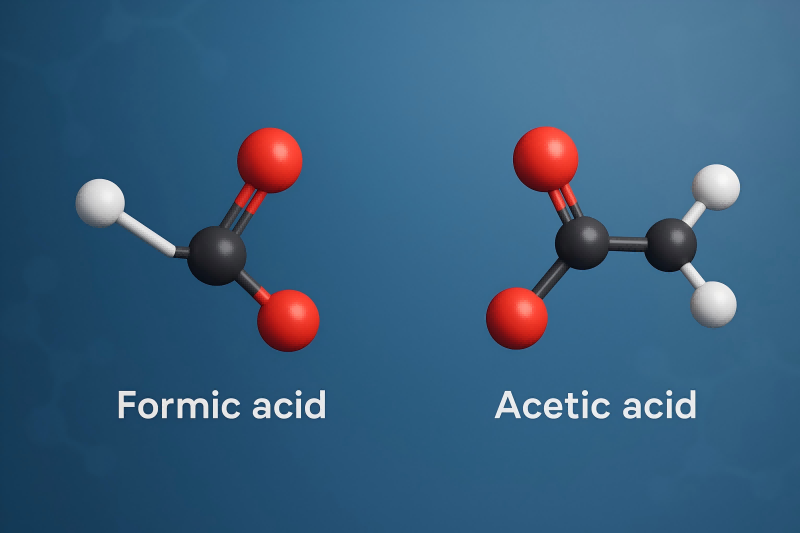
The key structural difference between these two acids is that formic acid contains no alkyl group, making it the simplest carboxylic acid.
This seemingly small difference has a significant impact on industrial performance.
Formic acid exhibits stronger acidity, greater reducing capability, and higher antimicrobial activity. Acetic acid, by contrast, is chemically milder and easier to handle in large-volume industrial systems.
As a result, formic acid is commonly selected when performance is the priority, while acetic acid is often preferred when operational simplicity and production economics are more important.
Production Technology and Supply Characteristics
Formic Acid Production
Most commercial formic acid is produced through the hydrolysis of methyl formate, which is generated from methanol and carbon monoxide.
This production route provides high-purity material suitable for industrial, technical, and feed-grade applications.
Because production capacity is more concentrated and demand is often application-specific, the formic acid market tends to be smaller and more specialized than the acetic acid market.
Acetic Acid Production
Modern acetic acid production is dominated by methanol carbonylation technologies such as the Monsanto and Cativa processes.
These technologies enable highly efficient, large-scale manufacturing and support global demand across chemicals, coatings, adhesives, plastics, solvents, and food-related industries.
As a result, acetic acid benefits from one of the most mature supply chains in the organic chemicals sector.
Industrial Applications by Industry
Leather and Textile Processing
Formic acid is widely used in leather tanning and textile dyeing due to its stronger acidity and rapid pH adjustment capability.
It enables efficient deliming, improves dye penetration, and supports consistent processing results.
Acetic acid is commonly used where gentler pH adjustment is required, particularly in dye fixation and finishing processes.
Animal Feed and Agriculture
Formic acid has become an important preservative and antimicrobial agent in modern feed production.
Its ability to reduce bacterial growth and improve feed hygiene has supported growing adoption in livestock nutrition programs worldwide.
Acetic acid is less commonly used for feed preservation but remains valuable as a chemical intermediate in agricultural formulations.
Chemical Manufacturing
Both acids serve as important chemical intermediates.
Formic acid is used in pharmaceutical synthesis, pesticide production, ester manufacturing, and specialty chemical reactions requiring higher reactivity.
Acetic acid is a cornerstone raw material for vinyl acetate monomer (VAM), acetic anhydride, acetate esters, solvents, coatings, and adhesive production.
Cleaning and Water Treatment
Formic acid provides strong descaling performance and is often selected for industrial cleaning applications involving mineral deposits and scale removal.
Acetic acid is widely used for general acidification, mild cleaning formulations, and water treatment processes where lower corrosiveness is preferred.
Oilfield Applications
In oil and gas operations, formic acid is frequently used for well stimulation, scale removal, and specialized acidizing treatments.
Acetic acid is commonly employed for pH control and support functions within drilling and production systems.
Technical Performance Comparison
Acid Strength
One of the most important differences is acidity.
With a pKa of 3.75, formic acid is significantly stronger than acetic acid, which has a pKa of 4.76.
This allows formic acid to achieve faster pH reduction and stronger catalytic performance at lower dosage levels.
Chemical Reactivity
Formic acid participates more readily in reduction reactions and certain catalytic processes.
Acetic acid is comparatively stable and predictable, making it well suited to continuous industrial production where process consistency is critical.
Thermal Stability
Acetic acid generally demonstrates greater thermal stability under industrial operating conditions.
Formic acid can decompose under elevated temperatures or catalytic environments, which may require additional process considerations in specialized applications.
Safety and Handling Considerations
Although both materials are routinely transported and used worldwide, their handling requirements differ.
| Parameter | Formic Acid | Acetic Acid |
|---|---|---|
| Corrosiveness | High | Moderate |
| Vapor Irritation | Higher | Lower |
| Storage Complexity | Higher | Lower |
| PPE Requirements | Strict | Standard Industrial Practice |
| Handling Risk | Higher | Moderate |
For formic acid, corrosion-resistant equipment, adequate ventilation, and appropriate personal protective equipment are essential.
Acetic acid remains hazardous at industrial concentrations but is generally easier to store and handle in large-volume operations.
Environmental Profile
Both formic acid and acetic acid are readily biodegradable organic acids.
Under normal environmental conditions, they break down naturally without long-term persistence in soil or water systems.
This biodegradability has contributed to their widespread use in industries seeking environmentally responsible processing chemicals.
However, concentrated releases can still cause localized environmental damage and should always be managed according to applicable regulations and wastewater treatment requirements.
Supply Considerations for Global Importers
When evaluating suppliers for formic acid or acetic acid, price should never be the only factor.
Professional importers and distributors typically assess:
- Product consistency
- REACH compliance
- SDS and COA availability
- Packaging options
- Export documentation support
- Container loading efficiency
- Lead time stability
- Technical support capability
For long-term supply programs, documentation quality and supply reliability often have a greater impact on total procurement cost than the initial product price.
How to Select a Reliable Supplier
A qualified supplier should be able to provide:
- Complete technical documentation
- REACH registration support where required
- Consistent batch quality
- Flexible packaging options
- Stable export experience
- Responsive technical communication
For distributors and industrial end users, establishing a long-term partnership with a supplier that understands both product performance and international trade requirements can significantly reduce sourcing risk.
Frequently Asked Questions
Is formic acid stronger than acetic acid?
Yes. Formic acid has a lower pKa value and provides stronger acidity than acetic acid, making it more effective in applications requiring rapid pH reduction or stronger catalytic activity.
Can formic acid replace acetic acid?
In some acidification applications, replacement may be possible. However, differences in acidity, reactivity, and corrosiveness mean that formulation validation is always recommended before substitution.
Which acid is better for animal feed preservation?
Formic acid is generally preferred due to its antimicrobial properties and proven effectiveness in feed hygiene management.
Which acid is easier to store and transport?
Acetic acid is generally easier to handle because it is less corrosive and requires less stringent operational controls than formic acid.
Are both products available for international export?
Yes. Both formic acid and acetic acid are widely traded globally and are available in multiple grades and packaging formats for international distribution.
Conclusion
While formic acid and acetic acid belong to the same chemical family, they serve very different industrial purposes.
Formic acid offers stronger acidity, higher reactivity, and superior antimicrobial performance, making it suitable for feed, leather, textile, oilfield, and specialty chemical applications.
Acetic acid provides broader availability, easier handling, and exceptional versatility across chemical manufacturing, food processing, coatings, solvents, and industrial production.
For importers, distributors, and industrial manufacturers, the best choice depends on application requirements, operational conditions, compliance needs, and long-term supply objectives.
At Niran Chemical, we support global distributors and manufacturers with reliable supply programs, complete export documentation, flexible packaging solutions, and professional sourcing support for industrial-grade formic acid and acetic acid.