

Alcohol Ethoxylates (AEO) are essential nonionic surfactants that serve as a cornerstone in the manufacturing of industrial cleaning products, household detergents, and specialized mild cleaning systems. In real-world production and global distribution, raw material purchasing decisions are rarely made based on abstract chemical theories alone. Instead, they are driven by pragmatic, end-use application requirements—specifically, cleaning efficiency, final product format, and the critical balance between cost and performance.
Among the most commercially vital grades—AEO-2, AEO-3, AEO-7, and AEO-9—each occupies a distinct niche across industrial and consumer cleaning markets. This guide cuts through the technical jargon to explain how these specific AEO grades are selected in practical industry scenarios, helping manufacturers, distributors, and formulators quickly identify the most efficient and cost-effective product for their targeted applications.
Quick Industry Selection Overview
The table below provides a practical benchmark, summarizing how each AEO grade is strategically positioned within modern industrial formulation and procurement workflows:
| Application Area | Recommended AEO Grade | Functional Role |
|---|---|---|
| Industrial degreasing / metal cleaning | AEO-2 / AEO-3 | Strong oil removal and heavy-duty surface cleaning |
| Heavy-duty detergent systems | AEO-7 | Balanced soil removal and robust foam stability |
| Household liquid detergent | AEO-7 | General-purpose surfactant backbone for daily cleaning |
| Dishwashing / multipurpose cleaners | AEO-7 | Stable, high-efficiency performance in anionic systems |
| Mild cleaning formulations | AEO-7 / AEO-9 | Controlled cleaning strength with enhanced aqueous solubility |
| Personal care cleansing support systems | AEO-9 | Ultra-mild performance paired with high water compatibility |
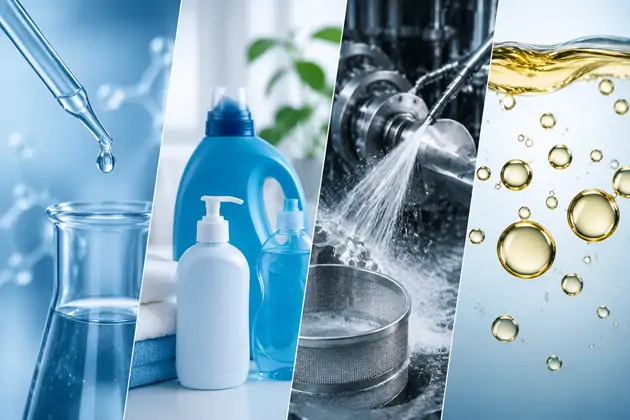
AEO-2 vs AEO-3 vs AEO-7 vs AEO-9 in Industrial Practice
AEO-2 – Strong Degreasing Surfactant
AEO-2 is the premier choice for aggressive formulation environments where uncompromising oil removal and deep degreasing performance are paramount. It is the industry standard in heavy-duty industrial metal cleaning formulations, high-intensity surface restoration products, and specialized systems designed to break down stubborn industrial oils and greases. Because of its lower ethoxylation level, the molecule possesses an exceptional affinity for highly hydrophobic contaminants, making it irreplaceable in demanding industrial environments where lighter surfactants fail.
AEO-3 – Industrial Emulsification Grade
AEO-3 bridges the gap between raw degreasing power and system processability by offering a finely tuned balance of oil removal and emulsification capabilities. This grade is widely deployed across industrial cleaning chemicals, hard surface maintenance systems, and complex emulsifier packages within detergent blends. Compared to its lower-EO counterparts like AEO-2, AEO-3 provides formulators with significantly improved handling flexibility in aqueous solutions while retaining the robust cleaning power necessary to tackle tough soils.
AEO-7 – General-Purpose Detergent Surfactant
Universally recognized as the workhorse of the detergent manufacturing industry, AEO-7 owes its immense popularity to an exceptionally well-balanced performance profile. It serves as the foundational ingredient in premium liquid laundry detergents, manual dishwashing liquids, everyday household cleaners, and highly versatile multi-purpose formulations. A key operational advantage of AEO-7 is its seamless, synergistic compatibility with mainstream anionic surfactants like SLES and LAS, making it a reliable core component in high-volume consumer cleaning systems.
AEO-9 – Mild and High-Solubility Surfactant
Characterized by a higher degree of ethoxylation, AEO-9 stands out for its superior water solubility, rapid dissolution rates, and remarkably mild interaction with surfaces and skin. It is heavily favored in mild household cleaners, low-irritation consumer formulations, high-clarity liquid detergents, and as a supporting co-surfactant in personal care cleansing systems. Formulators turn to AEO-9 when overall product aesthetics, long-term formulation stability, and gentle action are prioritized over aggressive, heavy-duty degreasing power.
How Different Industries Select AEO Grades
When translating product specifications into real-world factory applications, procurement and R&D teams evaluate three primary driving factors to guide their AEO selection:
Cleaning Strength Requirement: Formulations targeting heavy industrial contamination, tar, and grease inevitably rely on the hydrophobic strength of AEO-2 or AEO-3. Conversely, standard household soils are best addressed by AEO-7, while sensitive or specialty applications shift toward the gentler touch of AEO-9.
End-Use Product Type: The target market dictates the grade. Industrial chemical producers mandate the stronger, fast-acting AEO grades to minimize mechanical washing time. Meanwhile, household brands require the balanced, consumer-safe profiles of mid-range grades, and personal care or high-clarity systems specify the highly soluble, elevated EO variants.
Cost and Performance Balance: In large-scale, commercial detergent production, margin optimization is critical. AEO-7 is overwhelmingly chosen as the default manufacturing standard because it delivers an unbeatable cost-to-performance ratio alongside incredibly predictable blending behavior.
Compatibility in Real Formulation Systems
In the practical world of commercial chemical blending, AEO surfactants are rarely used as standalone solutions. Instead, they are engineered to act as performance multipliers when combined with established primary surfactants, most notably SLES (Sodium Laureth Sulfate), LAS (Linear Alkylbenzene Sulfonate), and CAPB (Cocamidopropyl Betaine).
When integrated into these blended surfactant matrices, AEO grades perform several vital functional roles:
- They significantly boost overall detergency and particulate cleaning efficiency through nonionic-anionic synergy.
- They help stabilize and refine the foam structure, ensuring consumer-preferred lather profiles.
- They accelerate the emulsification and suspension of oily soils, preventing redeposition on fabrics or surfaces.
- They enhance the thermodynamic balance and clarity of liquid formulations, preventing phase separation during storage.
Industry Application Summary
To summarize the global market landscape from a practical application perspective:
- The Industrial & Institutional (I&I) Sector consistently prioritizes AEO-2 and AEO-3 to achieve rapid, heavy-duty degreasing and oil splitting.
- The Mass-Market Household Detergent Industry relies heavily on AEO-7 as its dependable, highly adaptable formulation backbone.
- The Mild Cleaning & Specialty Chemicals Segment utilizes AEO-9 to ensure optimal solubility, low-temperature stability, and a gentler performance profile.
Ultimately, each grade plays a highly specific, calculated role in meeting the diverse performance, regulatory, and economic requirements of the global cleaning industry.
Supplier Perspective
At Niran Chemical, we understand that different industries demand vastly different surfactant profiles depending on their specific product designs, regional regulatory landscapes, and end-use environments. As a trusted, leading supplier of high-quality alcohol ethoxylates, we provide a comprehensive portfolio of AEO products spanning multiple application grades. Our manufacturing and supply chain infrastructure is fully optimized to support industrial cleaning manufacturers, consumer detergent producers, and global distributors with the consistent quality and reliable volume required to keep production lines running smoothly.
Frequently Asked Questions (FAQ)
1. What is the main difference between AEO-2, AEO-3, AEO-7, and AEO-9?
The main difference is the ethoxylation degree (EO number), which affects performance in real applications. Lower EO grades like AEO-2 and AEO-3 provide stronger oil removal, while higher EO grades like AEO-7 and AEO-9 offer better solubility and milder performance.
2. Which AEO grade is most commonly used in detergents?
AEO-7 is the most widely used grade in household and industrial detergent formulations. It offers a balanced performance between cleaning ability, foam stability, and compatibility with anionic surfactants such as SLES and LAS.
3. Which AEO is suitable for industrial degreasing applications?
AEO-2 and AEO-3 are typically used in industrial degreasing systems due to their stronger affinity for oils and grease. They are commonly applied in metal cleaning and heavy-duty industrial cleaning formulations.
4. Can AEO-9 be used in household cleaning products?
Yes. AEO-9 is often used in mild household cleaning systems where higher solubility and lower irritation potential are required. It is suitable for gentle cleaning formulations and specialty liquid cleaners.
5. Why are different AEO grades used instead of only one type?
Different cleaning systems require different performance characteristics. Industrial degreasing needs stronger oil removal, while household and mild systems require better balance and solubility. Using different AEO grades allows formulators to optimize cleaning performance, stability, and cost efficiency.