

In industrial chemistry, selecting the appropriate inorganic acid for manufacturing, cleaning, or processing operations is a critical decision. It directly impacts production efficiency, equipment lifespan, operational safety, and overall cost-effectiveness. Among the most widely utilized mineral acids, Phosphoric Acid (H₃PO₄) and Hydrochloric Acid (HCl) stand out as versatile workhorses across numerous sectors.
While both substances are primary agents for pH adjustment, metal treatment, and industrial cleaning, their chemical behavior, safety profiles, and cost structures diverge significantly. Industrial selectors and procurement professionals must understand these fundamental differences to optimize their supply chain and factory floor outcomes.
This comprehensive guide delivers a comparative analysis of Phosphoric Acid and Hydrochloric Acid, exploring their distinct chemical properties, primary industrial applications, and critical purchasing considerations.
Fundamental Chemical Properties and Safety Profiles
The core distinction between Hydrochloric Acid and Phosphoric Acid lies in their acidic strength, volatility, and molecular structure.
Hydrochloric Acid (HCl): The Strong, Volatile Acid
Hydrochloric Acid is a strong, monoprotic mineral acid that dissociates completely in aqueous solutions. It is highly corrosive and exceptionally aggressive toward metals. One of its most challenging operational characteristics is its volatility. At high concentrations, HCl continuously releases a pungent, hazardous hydrogen chloride gas (often referred to as acid mist). This necessitates robust ventilation systems, specialized scrubbers, and strict Personal Protective Equipment (PPE) for plant personnel. Furthermore, the residual chloride ions (Cl⁻) from HCl are notorious for inducing pitting corrosion in stainless steel, which can compromise industrial equipment if not meticulously managed.
Phosphoric Acid (H₃PO₄): The Moderate, Stable Acid
In contrast, Phosphoric Acid is a weak-to-moderate triprotic acid. It does not dissociate completely in water, making its reaction profile significantly more controlled and less aggressive than that of HCl. It is a non-volatile, odorless liquid that does not emit toxic fumes at ambient temperatures, vastly improving the factory working environment and simplifying workplace compliance. More importantly, rather than ruthlessly destroying metal substrates, Phosphoric Acid possesses a unique chemical affinity for iron, reacting with it to form a stable, protective layer.
Head-to-Head Comparison: Technical Specifications
To provide a clear, concise overview for technical directors and procurement teams, the table below highlights the primary physical and chemical differences between these two industrial acids.
Table 1: Technical Breakdown of Phosphoric Acid vs. Hydrochloric Acid
| Technical Parameter | Phosphoric Acid (H₃PO₄) | Hydrochloric Acid (HCl) |
|---|---|---|
| Acid Strength | Moderate / Weak (Triprotic) | Strong (Monoprotic) |
| Common Industrial Concentration | 75%, 85% (Food / Technical Grade) | 31%, 32%, 35% (Muriatic / Tech Grade) |
| Volatility & Odor | Non-volatile, completely odorless | Highly volatile, sharp, pungent suffocating odor |
| Corrosiveness to Stainless Steel | Low to moderate (Depends on temperature) | Extremely high (Causes severe pitting corrosion) |
| Fuming Behavior | Does not fume at ambient temperatures | Fumes heavily at concentrations above 30% |
| Reaction with Iron/Steel | Forms a protective iron phosphate coating | Aggressively dissolves metal, risks hydrogen embrittlement |
| Storage Material Requirements | FRP (Fiberglass), HDPE, 316L Stainless Steel | Rubber-lined steel, FRP, PVDF, PTFE |
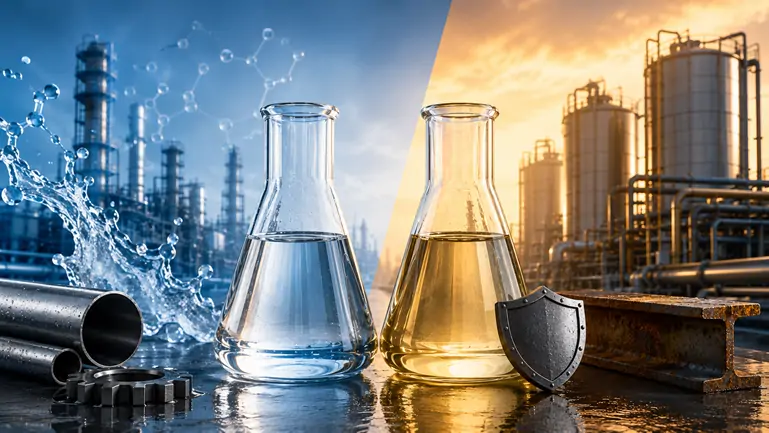
Key Industrial Application Showdowns
The choice between H₃PO₄ and HCl is dictated heavily by the specific downstream application and the regulatory standards of the target market.
Metal Treatment, Pickling, and Surface Finishing
In the metallurgical sector, both acids are used to remove rust, scale, and oxides from iron and steel, but they function via entirely different mechanisms.
Hydrochloric Acid Pickling: HCl is the industry standard for continuous, high-speed steel pickling. Because of its extreme acidity, it strips mill scale and rust at an unmatched velocity, maximizing throughput in high-volume steel mills. However, it requires the addition of specialized corrosion inhibitors to prevent the acid from over-attacking the base metal. Additionally, steel pickled with HCl is highly susceptible to “flash rusting” unless immediately treated with an oil or alkaline rinse.
Phosphoric Acid Rust Conversion: Phosphoric Acid is utilized when precision, surface preservation, and post-treatment protection are paramount. When applied to rusted steel, it converts iron oxide (Fe₂O₃) into Iron Phosphate (FePO₄), a black, insoluble, and chemically stable layer. This process—known as phosphating—not only halts the corrosion process but also acts as an exceptional primer or anchor profile for subsequent painting or powder coating.
Industrial and Commercial Cleaning (CIP Systems)
In institutional, industrial, and dairy cleaning, the selection of the descaling agent directly impacts equipment longevity and sanitary compliance.
The Food and Beverage Sector: Phosphoric Acid is the dominant choice for Clean-in-Place (CIP) systems in breweries, dairies, and beverage plants. It easily dissolves inorganic milkstone, beerstone, and calcium scale without damaging the premium stainless steel pipelines and pasteurizers. Its low volatility ensures that food manufacturing environments remain free from chemical vapors.
Heavy Industrial Masonry and Concrete Descaling: Hydrochloric Acid (frequently marketed under its commercial name, Muriatic Acid) is preferred for heavy-duty construction cleanup. It is highly effective at dissolving efflorescence, severe concrete spatters, and hard-water scaling on heavy machinery, provided the substrates can withstand its aggressive nature.
Water Treatment and pH Regulation
Both chemicals are reliable pH adjusters in industrial wastewater treatment, but the resulting byproducts pose unique environmental and chemical handling challenges.
Chloride Accumulation (HCl): Using Hydrochloric Acid introduces chloride ions into the effluent stream. While chlorides do not cause eutrophication, high chloride levels increase the salinity and corrosivity of the treated water, which can accelerate the degradation of downstream concrete infrastructure and discharge piping.
Phosphorus Loading (H₃PO₄): Utilizing Phosphoric Acid introduces phosphates into wastewater. While highly effective for precise pH neutralizations, excess phosphorus discharge is strictly regulated globally because it accelerates algae growth in natural water bodies (eutrophication). Therefore, its use requires careful monitoring or post-treatment precipitation.
Total Cost of Ownership and Supply Chain Dynamics
From a procurement perspective, evaluating these two acids extends far beyond the initial per-ton price point on an FOB invoice.
Initial Chemical Cost vs. Operational Value
Hydrochloric Acid is frequently generated as a byproduct of chlorinated hydrocarbon manufacturing. Consequently, its base chemical cost is generally lower than that of Phosphoric Acid, which relies on the energy-intensive thermal or wet-process extraction of phosphate rock.
Asset Depreciation and Logistics Costs
However, the industrial operations team must calculate the Total Cost of Ownership (TCO):
- Maintenance Overheads: The volatile nature of HCl leads to accelerated atmospheric corrosion of nearby factory infrastructure, electronics, and structural steel, increasing plant maintenance budgets.
- Storage and Transport Logistics: Due to its extreme corrosiveness and gas-emitting nature, HCl demands specialized, high-maintenance rubber-lined tanks or premium fluoropolymer transport vessels. Phosphoric Acid, being stable and non-fuming, offers much wider material compatibility, lowering long-term storage maintenance costs.
Ultimately, technical managers often discover that while Phosphoric Acid demands a higher initial investment, its ability to reduce asset degradation, eliminate flash-rusting steps, and provide a safer working environment delivers superior commercial value in specialized industrial setups.
Industrial Technical FAQs
Q1: Can Phosphoric Acid completely replace Hydrochloric Acid in industrial steel pickling?
Answer: While Phosphoric Acid can physically remove rust and scale, it cannot completely replace Hydrochloric Acid in high-speed, continuous steel manufacturing mills. HCl reacts at a much faster rate, which is required to maintain the high throughput of modern production lines. Phosphoric Acid is instead used as a specialized batch pickling agent or a secondary pre-treatment step when a phosphate coating is desired for subsequent paint adhesion.
Q2: What are the differences in storage requirements for bulk Hydrochloric Acid versus bulk Phosphoric Acid?
Answer: Bulk Hydrochloric Acid requires airtight, vented storage systems equipped with wet scrubbers to capture volatile acid fumes. Materials must be highly resistant to chloride-induced corrosion, such as fiberglass-reinforced plastic (FRP) or rubber-lined steel. Bulk Phosphoric Acid can be safely stored in high-density polyethylene (HDPE), standard FRP tanks, or high-grade (316L) stainless steel vessels without fuming hazards, though heating elements may be required in cold climates to prevent high-concentration formulas (like 85%) from freezing.
Q3: Why is Phosphoric Acid preferred over Hydrochloric Acid in the food, beverage, and dairy processing industries?
Answer: Phosphoric Acid is preferred due to its non-volatile nature and specific regulatory approval (Food Grade classification). It effectively removes mineral deposits and milkstone from processing equipment without introducing harsh, toxic chemical fumes into enclosed production spaces. Furthermore, unlike Hydrochloric Acid, it does not cause catastrophic stress-corrosion cracking or pitting in the stainless steel grades used in sanitary food production.
Q4: How do the environmental regulations for disposing of Hydrochloric Acid byproducts compare to Phosphoric Acid?
Answer: The disposal of both acids requires neutralization to an acceptable pH range. However, neutralized Hydrochloric Acid leaves high concentrations of chloride ions, which can increase wastewater salinity and are strictly monitored in industrial discharge permits. Neutralized Phosphoric Acid leaves phosphate residues; because phosphates are a major contributor to environmental eutrophication (harmful algal blooms), many municipalities impose strict legal limits on total phosphorus discharge, requiring facilities to install chemical precipitation systems to remove the phosphates before environmental release.
For international distributors, importers, and large-scale end-users, stabilizing your chemical supply chain is just as critical as choosing the right acid.
Conclusion
As a reliable B2B chemical trading partner, Niran Chemical delivers consistent, high-volume sourcing for both Phosphoric Acid and Hydrochloric Acid. We ensure full regulatory compliance, comprehensive documentation (TDS/SDS), and seamless global logistics tailored to container-load demands.