

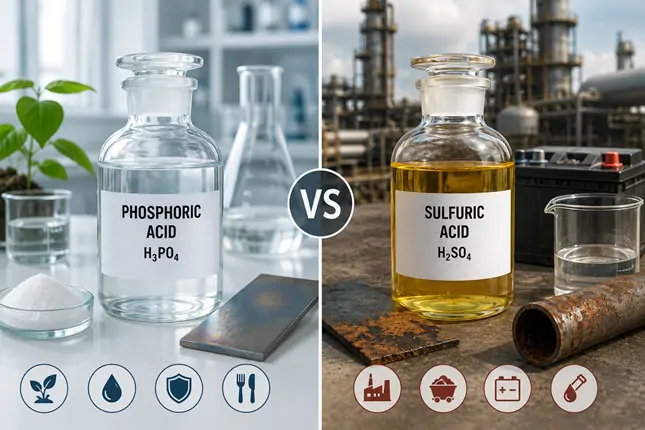
Phosphoric acid and sulfuric acid are two of the most widely consumed inorganic acids globally, serving as backbones for everything from agricultural inputs to precision manufacturing. However, despite sharing common functions like pH adjustment and metal treatment, they operate on completely different chemical and economic scales. In industrial procurement, treating them as interchangeable variables is a costly miscalculation.
The fundamental divergence lies in their chemical nature: sulfuric acid is a highly aggressive, reactive strong acid optimized for bulk, heavy industrial processing. Conversely, phosphoric acid is a medium-strength acid providing controlled reactivity, typically specified where equipment longevity, process safety, and regulatory compliance outweigh sheer neutralization power.
For international importers and distributors, plant managers, and procurement specialists, a correct sourcing decision requires balancing upfront chemical costs against long-term operational impact.
Technical Comparison Matrix
| Property | Phosphoric Acid (H₃PO₄) | Sulfuric Acid (H₂SO₄) |
|---|---|---|
| Acid Strength | Moderate / Weak-to-Medium | Very Strong / Fully Ionized |
| Reactivity & Passivation | Controlled; forms protective coatings | Aggressive; highly exothermic |
| Corrosion Profile | Low-to-moderate on standard alloys | High; requires specialized piping/lining |
| Food-Grade Options | Widely available (FCC / E338) | Not applicable for direct food use |
| Commercial Concentrations | 75%, 80%, 85% | 93%, 98% |
| Handling & Logistics | Standard corrosive handling protocols | High-risk; strict temperature and moisture controls |
| Market Price Point | Higher per metric ton | Lower per metric ton (commodity-driven) |
| Primary Value Driver | Process control and product quality | Reaction efficiency and low cost |
Understanding Phosphoric Acid (H₃PO₄)
Phosphoric acid is a non-volatile, triprotic acid characterized by its moderate acidity and unique ability to passivate metals. Unlike mineral acids that aggressively strip substrates, phosphoric acid interacts with metal surfaces to form an insoluble phosphate layer, preventing further oxidation.
Its commercial value spans several critical tiers:
- Agriculture: Acting as the pure phosphorus source for high-analysis fertilizers.
- Surface Finishing: Driving rust conversion, phosphating pretreatments, and chemical polishing.
- Water & Wastewater Treatment: Supplying essential nutrients to biological treatment flora while controlling downstream scale and corrosion.
- Food & Beverage Processing: Functioning as a clean acidulant in carbonated beverages and complex food matrices.
Because it does not volatilize or cause rapid structural degradation to standard process equipment, it is favored in precision formulations and high-spec industrial environments.
Understanding Sulfuric Acid (H₂SO₄)
Sulfuric acid is a heavy commodity mineral acid and a primary benchmark of global industrial capacity. It is a highly corrosive, diprotic acid with an immense affinity for water—a property that makes it both an excellent dehydrating agent and a hazardous chemical to dilute.
Its application footprint is dominated by volume-driven chemistry:
- Lixiviant in Mining: Extensively used in the heap leaching of copper, uranium, and nickel ores.
- Chemical Synthesis & Refining: Serving as a catalyst in petroleum alkylation and an agent in titanium dioxide production.
- Wastewater Treatment: Utilized for high-volume, low-cost pH neutralization in heavy industrial effluents.
- Lead-Acid Batteries: Operating as the standard electrolyte solution.
The driving force behind choosing sulfuric acid is raw reaction efficiency. It drops pH faster and drives chemical conversions at a fraction of the cost of alternative acids, provided the plant is engineered to handle its aggressive corrosion profile.
Cross-Industry Application Comparison
Fertilizer Production: A Shared Value Chain
A common misconception among general importers or distributors is that these two acids compete directly in fertilizer manufacturing. In reality, they are deeply complementary within the production chain.
Sulfuric acid is the primary acidulant used to digest insoluble phosphate rock, yielding crude green phosphoric acid. This intermediate acid is then concentrated and reacted with ammonia to produce mainstream finished fertilizers like Monoammonium Phosphate (MAP) and Diammonium Phosphate (DAP). Therefore, the fertilizer market’s demand for sulfuric acid is heavily dependent on global phosphorus mining and processing margins.
Metal Treatment and Surface Finishing
In metallurgy, the transition from one acid to the other changes the entire process outcome:
- Sulfuric acid is typically used in heavy steel pickling lines to rapidly strip thick oxide scales from hot-rolled steel. While highly efficient, the reaction is aggressive; without tight inhibitor dosing, the acid will quickly over-pickle and attack the base metal.
- Phosphoric acid is specified for precision surface treatment. Rather than continuous stripping, it chemically converts iron oxides into a stable, passivated iron phosphate coating. This layer acts as an exceptional anchor for industrial paints and powder coatings, offering superior under-film corrosion resistance.
Industrial Water Treatment
For high-volume industrial neutralization, sulfuric acid remains the standard economic default. However, plant engineers increasingly specify phosphoric acid in specialized circuits.
While more expensive upfront, phosphoric acid eliminates the risk of calcium sulfate (gypsum) scaling in hard-water systems—a frequent failure point when using sulfuric acid. Furthermore, in biological wastewater plants, the residual phosphate acts as an essential macronutrient for active sludge biomass, reducing the need for separate nutrient dosing.
Food and Beverage Compliance
This represents an absolute regulatory boundary. Phosphoric acid can be refined to extreme purity levels to meet Food Chemicals Codex (FCC) and European food additive (E338) standards, making it standard in cola formulations and dairy cleaning lines. Sulfuric acid has no direct equivalence in food ingredient matrices and is legally restricted from these applications.
TCO Analysis: Evaluating Cost vs. Performance
When looking at a spot market quotation, sulfuric acid always appears more attractive on a pure dollar-per-ton basis. However, an experienced industrial importer/distributor evaluates the Total Cost of Ownership (TCO).
The Sulfuric Acid Trade-Off
Sourcing sulfuric acid guarantees low initial chemical spend and excellent volume efficiency. The trade-off appears in infrastructure maintenance. Utilizing 93% or 98% H₂SO₄ requires specialized alloy piping, strict moisture-exclusion systems to prevent severe dilution-corrosion, and complex safety measures to manage the intense heat generated during process dilution.
The Phosphoric Acid Premium
Conversely, the higher market price of phosphoric acid reflects its complex supply chain and refining steps. Choosing phosphoric acid allows plants to utilize lower-spec stainless steel or polymer-lined infrastructure, significantly lowering capital expenditure on maintenance, replacement valves, and specialized storage tanks. In short, the higher chemical cost is often offset by reduced depreciation of capital assets.
Supply Chain & Sourcing Considerations for Importers and Distributors
Navigating the international procurement of these acids requires strict attention to chemical grades, concentrations, and supply dynamics.
Grades and Strengths
Importers and distributors must align specifications precisely with the end-user’s application:
- Phosphoric Acid: Typically traded as 75%, 80%, or 85% commercial strengths. For food and pharmaceutical buyers—now referred to as food/pharma importers—verifying FCC compliance and heavy metal thresholds (such as arsenic and lead limits) is mandatory.
- Sulfuric Acid: Most commonly shipped at 93% or 98% concentrations to optimize freight logistics. At these concentrations, the acid can be transported in carbon steel containers, whereas lower dilutions require highly specialized equipment due to increased corrosivity.
Compliance and Shipping Documentation
Because both chemicals are highly corrosive, international shipments are subject to strict maritime and customs scrutiny. Importers and distributors must ensure their suppliers provide accurate, current documentation, including:
- Certificate of Analysis (COA) detailing exact impurity profiles (especially iron, sulfate, or heavy metal contamination).
- Compliant Safety Data Sheets (SDS/MSDS) aligned with GHS standards.
- Proper IMDG (International Maritime Dangerous Goods) certification for ocean freight.
Market Volatility and Availability
Sulfuric acid availability is heavily tied to global smelting operations and oil refining, as it is frequently produced as a mandatory byproduct of sulfur recovery. Phosphoric acid, however, is deeply tied to the geopolitics of phosphate rock mining and seasonal agricultural demand. Sourcing strategies should factor in these distinct market drivers to ensure long-term supply stability.
Summary for Strategic Procurement
Ultimately, your choice should not be decided by acid strength alone, but by the operational realities of your application:
- Select sulfuric acid when your objective is high-volume, low-cost chemical processing, and your plant infrastructure is fully equipped to handle aggressive, highly exothermic reactions.
- Select phosphoric acid when your process demands controlled chemical reactivity, minimized equipment corrosion, food-grade compliance, or integrated metal passivation.
At Niran Chemical, we manage full-scale supply chains for both phosphoric and sulfuric acids, delivering technical, industrial, and food-grade specifications to global importers and distributors. We work alongside procurement teams to ensure that concentration parameters, purity profiles, and logistics compliance align perfectly with your manufacturing and commercial goals.