

In water treatment, Calcium Hypochlorite and Trichloroisocyanuric Acid (TCCA) are often grouped together as standard chlorine disinfectants. On paper, they may look similar—both release active chlorine, both are widely traded, and both are used globally across water systems.
But in real operations, they are rarely used in the same way.
From what we have seen working with importers and large-scale users, the difference between these two products is less about chemistry, and more about how a system behaves. Some systems need chlorine to act immediately. Others need it to stay effective over time. This simple distinction—fast versus sustained—often determines which product actually works better in practice.
Quick Comparison Overview
Before moving into application scenarios, a quick side-by-side view helps frame the discussion:
| Item | Calcium Hypochlorite | TCCA |
|---|---|---|
| Available Chlorine | 65–70% | Around 90% |
| Dissolution Behavior | Rapid | Controlled / Slow |
| Chlorine Release | Immediate spike | Sustained release |
| Stability in Storage | Moderate | High |
| Typical Form | Powder / Granular | Tablet / Powder |
| pH Impact | Raises pH | Slightly lowers pH |
| Common Role | Shock / emergency use | Maintenance / continuous use |
The numbers tell part of the story. The rest becomes clearer when these products are placed into real-world situations.
Emergency Water Treatment: When Time Is the Constraint
Imagine a temporary water supply system set up after a disruption. There is no time to fine-tune dosing curves or wait for gradual stabilization—the priority is to establish safe water conditions as quickly as possible.
This is where Calcium Hypochlorite tends to be used.
Its rapid dissolution allows operators to introduce a high level of available chlorine almost immediately. Many of our importer clients supplying to emergency projects or infrastructure-limited regions prefer it for exactly this reason: it works fast, and it works without requiring sophisticated dosing equipment.
At the same time, that speed comes with a trade-off. Chlorine residual drops relatively quickly, which means the system requires ongoing attention if continuous disinfection is needed. In short, it is highly effective at starting control, but not designed to maintain it over long periods.
Continuous Treatment Systems: When Stability Matters More Than Speed
As soon as a system shifts from emergency response to routine operation, the logic changes. Instead of reacting quickly, the goal becomes maintaining a consistent disinfectant level with minimal fluctuation.
In these conditions, TCCA is often the more practical choice.
Its slower dissolution profile allows chlorine to be released gradually, supporting a stable residual over time. For many of our customers managing municipal supply, industrial circulation, or automated dosing systems, this translates into fewer manual interventions and more predictable system performance.
In large-scale operations, this difference is not just technical—it affects labor planning, maintenance cycles, and overall operating cost. A product that reduces dosing frequency can simplify the entire workflow.
Swimming Pools: Where Environment Shapes the Choice
Swimming pool systems highlight another dimension of this comparison: environmental exposure.
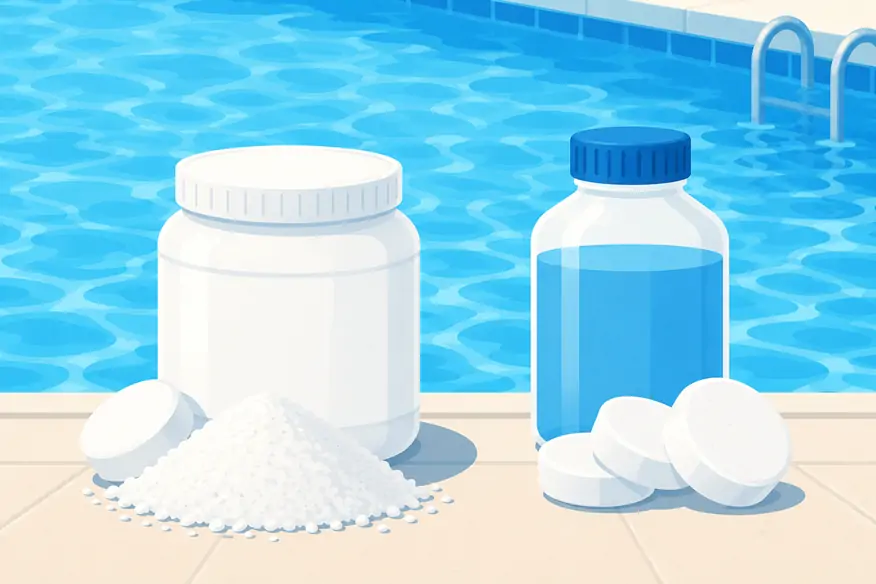
Under sunlight, free chlorine degrades quickly. In a pool that is used daily, maintaining a consistent chlorine level becomes a continuous challenge. This is one of the reasons why TCCA is widely used in pool maintenance. Its structure allows chlorine to remain active for longer periods, helping operators maintain stable water quality throughout the day.
That said, Calcium Hypochlorite still plays a role. In many pool operations, it is used for shock treatment—when chlorine levels need to be corrected quickly after heavy usage or contamination. From what we observe among distributors, it is common for both products to be supplied together, not as substitutes, but as complementary tools for different moments in the same system.
Beyond Performance: What Importers Actually Consider
While technical performance is important, our importer partners often evaluate these products through a broader operational lens.
One recurring consideration is dosing frequency. Faster-acting products like Calcium Hypochlorite may require more frequent application and closer monitoring. TCCA, with its sustained release, can extend dosing intervals and reduce day-to-day intervention. Over time, this difference can influence labor requirements and handling costs.
Water chemistry also plays a role. Calcium Hypochlorite tends to increase pH levels, which may require adjustment depending on system conditions. TCCA behaves differently, contributing to more stable chlorine retention but introducing other variables that need to be managed in long-term use. For experienced operators, these are not obstacles, but part of how the system is balanced.
Logistics and storage are another practical factor. TCCA’s higher stability makes it more predictable over longer storage periods, which is often preferred in international supply chains. For importers handling bulk shipments or extended inventory cycles, this consistency can be just as important as the product’s performance in water.
Conclusion: Not Just a Product Choice, but an Operational One
Calcium Hypochlorite and TCCA are often compared as alternatives, but in practice, they solve different problems.
Calcium Hypochlorite is designed for speed—for situations where immediate disinfection is required and rapid chlorine availability is critical. TCCA is designed for continuity—for systems that depend on stable, long-lasting chlorine levels with minimal fluctuation.
For importers and large-scale users, the decision is rarely about choosing one over the other in isolation. It is about understanding how each product fits into the broader operation. In many cases, the most effective strategy is to use both, each at the point where it performs best.
At Niran Chemical, we work closely with importers and industrial users across different markets, supplying both Calcium Hypochlorite and TCCA with consistent quality and stable export standards. Based on different application needs—whether for emergency response, pool maintenance, or continuous water treatment—we support our partners in selecting the right product combination for their specific systems.
Because in water treatment, the difference is not just how much chlorine is added—but how it performs across the entire operation.
FAQ
1. Calcium Hypochlorite vs Sodium Hypochlorite: Which one is better for water treatment?
Both are widely used disinfectants, but they differ in form, stability, and application. Calcium Hypochlorite is typically supplied as a solid with higher available chlorine and better suitability for transport and storage, while Sodium Hypochlorite is a liquid solution often used in continuous dosing systems. In many export scenarios, our customers prefer Calcium Hypochlorite for bulk shipment and longer shelf life, especially in regions where on-site generation or storage conditions are limited.
2. Can TCCA be used for drinking water treatment?
TCCA is more commonly used in pool and industrial systems due to its slow-release characteristics. While it can be used in certain controlled water treatment applications, Calcium Hypochlorite is generally preferred for drinking water systems because of its faster dissolution and easier control of dosing.
3. Why is TCCA widely used in swimming pools?
TCCA provides a more stable and sustained chlorine release, which is important in outdoor environments where chlorine degrades quickly under sunlight. This allows pool operators to maintain consistent chlorine levels with fewer adjustments.
4. Is Calcium Hypochlorite suitable for continuous dosing systems?
It can be used, but it is not always the most efficient choice for long-term continuous systems. Due to its fast chlorine release, it often requires more frequent dosing. Many large-scale users choose TCCA or combine both products depending on system design.
5. How do importers usually choose between Calcium Hypochlorite and TCCA?
From our experience, the decision is mainly based on downstream application. Customers supplying emergency treatment or short-cycle use tend to choose Calcium Hypochlorite, while those serving pool maintenance or continuous systems prefer TCCA. Logistics, storage conditions, and dosing methods are also key factors in the final selection.