

Xanthan gum and carbomer are the two most commonly specified thickeners in cosmetic and personal care formulation. Both build viscosity in water-based systems, both are used at low concentrations, and both appear in everything from serums to pharmaceutical gels. But they work through fundamentally different mechanisms, respond differently to pH and electrolytes, and produce distinctly different textures. Choosing between them is not a matter of preference — it is a formulation decision with real consequences for product stability, sensory profile, and regulatory positioning.
Short answer: Carbomer is a synthetic polymer that produces crystal-clear, short-flow gels with excellent thickening efficiency — but requires neutralization and is sensitive to electrolytes. Xanthan gum is a naturally derived polysaccharide that produces long-flow, pseudoplastic gels with broad pH and electrolyte tolerance — and is COSMOS-approved for natural formulations. Neither is universally better; the right choice depends on the product format, pH, electrolyte content, and brand positioning.
What Are Xanthan Gum and Carbomer?
Xanthan Gum
Xanthan gum is a high-molecular-weight polysaccharide produced by aerobic fermentation of sugars by Xanthomonas campestris. It is naturally derived, COSMOS-approved, and suitable for organic and natural certified formulations. It disperses in both cold and hot water, requires no neutralization, and builds viscosity across a wide pH range (3.0–12.0). Its defining rheological characteristic is pseudoplasticity: viscosity drops dramatically under shear and recovers immediately when force is removed.
- INCI: Xanthan Gum | CAS: 11138-66-2 | Origin: Microbial fermentation | COSMOS: Approved
Niran Chemical supplies cosmetic-grade Xanthan Gum with COA, MSDS, and TDS available for B2B buyers.
Carbomer
Carbomer is a synthetic polymer of acrylic acid, cross-linked with allyl sucrose or allyl pentaerythritol. It is sold under various trade names (Carbopol being the most recognized) and in multiple grades — Carbomer 940, 980, 934, 941, and others — each with slightly different molecular weight and cross-linking density that affect the final gel texture and clarity. Carbomer requires neutralization with a base (typically sodium hydroxide, triethanolamine, or aminomethyl propanol) to activate its thickening function. It is highly sensitive to electrolytes, which disrupt its polymer network and reduce viscosity.
- INCI: Carbomer | CAS: 9003-01-4 | Origin: Synthetic (acrylic acid polymer) | COSMOS: Not approved
Niran Chemical supplies cosmetic-grade Carbomer in multiple grades including Carbomer 940 and Carbomer 980.
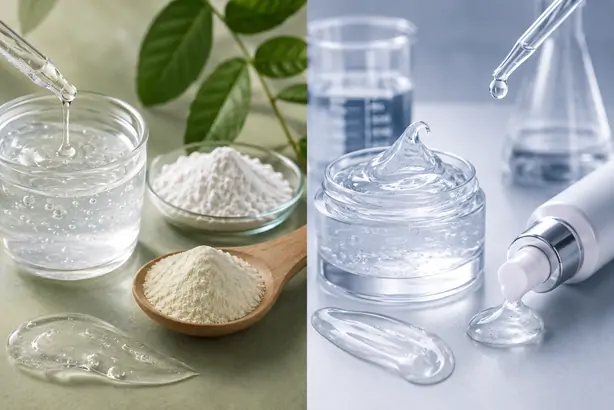
Xanthan Gum vs Carbomer: Key Properties
| Property | Xanthan Gum | Carbomer |
|---|---|---|
| Origin | Natural (microbial fermentation) | Synthetic (acrylic acid polymer) |
| COSMOS approved | Yes | No |
| Rheology type | Long flow (pseudoplastic / shear-thinning) | Short flow (viscoelastic gel) |
| Gel clarity | Slightly hazy to translucent | Crystal clear (especially 940/980) |
| Neutralization required | No | Yes (NaOH, TEA, or AMP) |
| pH stability range | 3.0–12.0 | 5.0–9.0 (optimal 6.0–8.0) |
| Electrolyte sensitivity | Good tolerance | High sensitivity — salts reduce viscosity |
| Typical use level | 0.1%–1.0% | 0.1%–0.5% |
| Thickening efficiency | Good | Excellent (high viscosity at low %) |
| Particle suspension | Excellent | Good |
| Skin feel | Slightly tacky at high concentrations | Smooth, non-tacky, elegant |
| Temperature stability | Stable 0°C–80°C | Stable, but viscosity may vary with temperature |
| Biodegradability | Readily biodegradable | Not readily biodegradable |
Understanding the Rheology Difference
The most practically important difference between xanthan gum and carbomer is their flow behavior — and this is where the terms “long flow” and “short flow” matter.
Xanthan gum produces long-flow rheology. When you scoop or pour a xanthan gum gel, it flows and stretches — it has a stringy, cohesive quality. This is because its pseudoplastic network reforms slowly after shear. Long-flow gels spread easily and feel lightweight on skin, but at higher concentrations they can feel slightly tacky or “snotty.” This is why xanthan gum is typically used at 0.1%–0.5% in leave-on products.
Carbomer produces short-flow rheology. A carbomer gel breaks cleanly when scooped — it does not string or trail. This “short flow” behavior is what gives carbomer gels their elegant, non-drip texture that consumers associate with premium skincare. The gel holds its shape, dispenses cleanly from a pump, and spreads smoothly without tackiness. This is why carbomer is the default thickener for clear hair styling gels, pharmaceutical topicals, and premium skincare serums where sensory elegance is a priority.
For a deeper look at xanthan gum’s pseudoplastic behavior and its applications across product formats, see our article on Xanthan Gum in Skincare.
Applications: Where Each Thickener Fits
| Application | Preferred Choice | Reason |
|---|---|---|
| Crystal-clear gels (hair styling, serums) | Carbomer | Superior clarity; short-flow texture; elegant dispensing |
| Natural / COSMOS-certified formulations | Xanthan gum | COSMOS-approved; biodegradable; fermentation-derived |
| Acidic formulations (pH < 5, AHA/vitamin C) | Xanthan gum | Stable at pH 3.0+; carbomer loses viscosity below pH 5 |
| Salt-containing systems (shampoos, electrolyte-rich) | Xanthan gum | Electrolyte-tolerant; carbomer viscosity collapses with salts |
| Physical sunscreens (mineral UV filters) | Xanthan gum | Superior particle suspension; electrolyte tolerance |
| Pharmaceutical topical gels | Carbomer | Precise rheology control; well-established in pharma monographs |
| Face masks (rinse-off, sheet mask liquid) | Xanthan gum | Shear-thinning aids application; broad pH compatibility |
| Premium skincare serums (clear, elegant) | Carbomer | Crystal clarity; smooth skin feel; short-flow dispensing |
| Emulsion stabilization | Both (context-dependent) | Xanthan gum for natural systems; carbomer for clear emulsions |
Safety and Regulatory Status
Both xanthan gum and carbomer are well-established in cosmetic use with favorable safety profiles.
Xanthan gum has been assessed by the CIR Expert Panel and concluded safe for cosmetic use at concentrations up to 2%. It is non-irritating, non-comedogenic (rating 0/5), and non-sensitizing. Its large molecular size prevents skin penetration, eliminating systemic absorption concerns. It is COSMOS-approved, EWG Skin Deep rated 1 (lowest hazard), and suitable for vegan formulations.
Carbomer has also been assessed by the CIR Expert Panel as safe for cosmetic use. It is non-irritating at typical use concentrations and has a long history of use in both cosmetics and pharmaceutical topicals. The main safety consideration is the neutralizing agent used: triethanolamine (TEA), a common neutralizer, has faced scrutiny due to potential nitrosamine formation when combined with certain other ingredients. Sodium hydroxide (NaOH) or aminomethyl propanol (AMP) are preferred neutralizers in formulations where this is a concern.
From a regulatory standpoint, carbomer is not COSMOS-approved and cannot be used in certified natural or organic formulations. For brands pursuing ECOCERT, COSMOS, or NATRUE certification, xanthan gum is the required alternative.
How to Choose Between Xanthan Gum and Carbomer
- Natural, organic, or COSMOS-certified formulations: Xanthan gum only. Carbomer is not COSMOS-approved.
- Crystal-clear gels or premium serums where sensory elegance is critical: Carbomer (940 or 980 for maximum clarity). Xanthan gum produces slightly hazy gels.
- Acidic formulations (pH below 5): Xanthan gum. Carbomer requires pH 5.0+ to maintain viscosity.
- Formulations containing electrolytes or salts: Xanthan gum. Carbomer viscosity drops significantly in the presence of salts.
- Pharmaceutical topical gels: Carbomer is the industry standard, with established monographs in USP and EP.
- Physical sunscreens with mineral UV filters: Xanthan gum for its superior particle suspension and electrolyte tolerance.
- Cost-sensitive formulations: Both are cost-effective at typical use levels. Carbomer achieves high viscosity at lower concentrations (0.1%–0.3%), which can offset its slightly higher unit cost.
- Combination approach: Some formulations use both — carbomer for primary thickening and clarity, xanthan gum for particle suspension and electrolyte tolerance. This is common in physical sunscreens and complex emulsions.
Frequently Asked Questions
Is xanthan gum better than carbomer?
Neither is universally better. Carbomer produces clearer gels with a more elegant skin feel and is preferred for pharmaceutical topicals and premium clear serums. Xanthan gum is naturally derived, COSMOS-approved, and performs better in acidic or electrolyte-containing systems. The right choice depends on the product format, pH, electrolyte content, and whether natural certification is required.
Can xanthan gum and carbomer be used together?
Yes. Combining them is a legitimate formulation strategy. Carbomer provides primary thickening and clarity; xanthan gum contributes particle suspension and electrolyte tolerance. This combination is used in some physical sunscreens and complex emulsions where both properties are needed.
Why does carbomer require neutralization?
Carbomer is an acidic polymer. In its unneutralized state, it disperses in water but does not build significant viscosity. Adding a base (NaOH, TEA, or AMP) neutralizes the carboxylic acid groups on the polymer chain, causing them to ionize and repel each other. This electrostatic repulsion causes the polymer to expand and form a three-dimensional gel network — which is what creates viscosity. Without neutralization, carbomer remains a low-viscosity dispersion.
What is the difference between Carbomer 940 and Carbomer 980?
Both are widely used cosmetic grades. Carbomer 940 produces slightly higher viscosity at equivalent concentrations and is the most commonly specified grade in cosmetics. Carbomer 980 has a slightly different cross-linking density that produces a somewhat smoother, more elegant gel with marginally better clarity. In practice, the two are often interchangeable, with the choice depending on the specific viscosity and texture target of the formulation.
Conclusion
Xanthan gum and carbomer are complementary tools rather than direct substitutes. Carbomer delivers the crystal-clear, short-flow gels that define premium skincare and pharmaceutical topicals. Xanthan gum delivers broad-spectrum stability, natural origin, and performance in conditions where carbomer fails — acidic pH, electrolyte-rich systems, and natural-certified formulations. Understanding the rheological and chemical differences between them is what allows formulators to make the right call for each product.
Niran Chemical supplies both Xanthan Gum and Carbomer in cosmetic grades, with full technical documentation available on request.