
Phenoxyethanol is one of the most widely used preservatives in modern cosmetics and personal care. Walk through the ingredient lists of shampoos, lotions, wet wipes, and makeup products globally, and you will find it in the majority of them. It replaced parabens as the industry’s default preservative over the past decade — not because it is perfect, but because it works reliably, is accepted by regulators worldwide, and carries a cleaner consumer perception than the alternatives it displaced.
Short answer: Phenoxyethanol is a synthetic aromatic glycol ether used as a broad-spectrum preservative in cosmetics, personal care, pharmaceuticals, and industrial formulations. It prevents bacterial, yeast, and mold contamination in water-containing products. It is approved globally at concentrations up to 1% in cosmetics and is one of the most extensively studied preservatives in the industry.
What Is Phenoxyethanol?
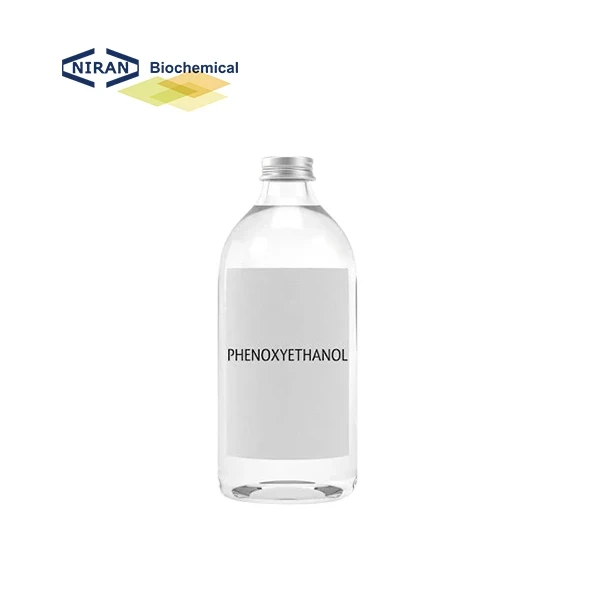
Phenoxyethanol is an aromatic glycol ether — a clear, slightly oily liquid with a mild, faintly rose-like odor. It is produced synthetically by the reaction of phenol with ethylene oxide. A naturally occurring form exists in green tea and chicory, but the commercial ingredient used in cosmetics and industrial applications is entirely synthetic.
- INCI name: Phenoxyethanol
- CAS number: 122-99-6
- Chemical formula: C₈H₁₀O₂
- Molecular weight: 138.16 g/mol
- Appearance: Colorless to pale yellow oily liquid
- Odor: Mild, faintly floral
- Solubility: Slightly soluble in water (~2.6 g/L at 20°C); freely soluble in ethanol, propylene glycol, and oils
- pH stability: Effective across pH 3–10
- Thermal stability: Stable up to approximately 85°C
Niran Chemical supplies cosmetic-grade Phenoxyethanol with COA, MSDS, and TDS available for B2B buyers.
How Phenoxyethanol Works
Phenoxyethanol kills microorganisms through a two-stage mechanism. First, it associates with and disrupts the bacterial cell membrane, impairing cellular function and preventing reproduction. Second, it causes irreversible leakage of intracellular contents through the damaged membrane, depleting the cell of nutrients and ultimately killing it.
This dual action makes phenoxyethanol effective against a broad range of microorganisms. It is particularly potent against gram-negative bacteria — including Pseudomonas aeruginosa and E. coli — which are among the most problematic contaminants in cosmetic formulations and are resistant to many other preservatives. It also provides activity against gram-positive bacteria, yeast, and mold, though its coverage against fungi is weaker and is typically supplemented by pairing with other preservatives or boosters.
One notable characteristic: microorganisms have shown limited ability to develop resistance to phenoxyethanol, unlike many other preservatives. Studies dating back to the 1980s demonstrated that bacterial strains including Pseudomonas aeruginosa and Staphylococcus aureus adapted to all tested preservatives except phenoxyethanol. This resistance stability contributes to its long-term reliability as a preservation system.
Key Properties
| Property | Value |
|---|---|
| CAS number | 122-99-6 |
| Molecular weight | 138.16 g/mol |
| Appearance | Colorless to pale yellow oily liquid |
| Boiling point | ~245°C |
| Flash point | ~121°C |
| Water solubility | ~2.6 g/L at 20°C (slightly soluble) |
| pH stability range | 3.0 – 10.0 |
| Thermal stability | Stable up to ~85°C |
| Typical use level (cosmetics) | 0.5% – 1.0% |
| Maximum permitted (EU) | 1.0% |
| Antimicrobial spectrum | Bacteria (esp. gram-negative), yeast, mold |
| Formaldehyde release | None |
Applications by Industry
| Industry | Typical Applications | Role |
|---|---|---|
| Cosmetics & Personal Care | Lotions, creams, shampoos, conditioners, body washes, facial cleansers, makeup, wet wipes | Primary preservative; prevents microbial contamination in water-based formulations |
| Skin Care | Serums, toners, moisturizers, sunscreens, eye creams | Broad-spectrum preservation; compatible with most actives including retinol, AHAs, and vitamin C |
| Hair Care | Shampoos, conditioners, hair masks, leave-in treatments | Preservation in surfactant-rich systems; effective against gram-negative bacteria common in rinse-off products |
| Baby & Sensitive Skin | Baby wipes, gentle cleansers, diaper creams | Used at lower concentrations; preferred over formaldehyde-releasing preservatives |
| Pharmaceuticals | Topical preparations, ophthalmic products, wound care | Antimicrobial preservative; listed in British Pharmacopoeia and US Pharmacopoeia |
| Household & Industrial | Liquid detergents, surface cleaners, wet wipes, water-based coatings, adhesives | Preservation of water-based industrial formulations; prevents spoilage during storage |
Regulatory Status by Market
Phenoxyethanol is one of the most broadly accepted preservatives globally, with regulatory approval across all major markets:
- European Union: Permitted in cosmetics at a maximum concentration of 1.0% under EU Cosmetics Regulation (EC) No. 1223/2009 (Annex V, entry 29). The SCCS has assessed phenoxyethanol and concluded it is safe at this concentration for most applications. The SCCS has noted additional caution for products used on infants under 3 years, particularly leave-on products applied to the nappy area.
- United States (FDA): No specific concentration limit in cosmetics; the Cosmetic Ingredient Review (CIR) Expert Panel has assessed phenoxyethanol as safe for use in cosmetics. Listed in the US Pharmacopoeia as an antimicrobial preservative for pharmaceutical use.
- Japan: Permitted in cosmetics at up to 1.0% by the Ministry of Health, Labour and Welfare (MHLW).
- China: Permitted in cosmetics at up to 1.0% under GB standards.
- COSMOS/Natural certification: Not approved for COSMOS-certified natural or organic formulations. Brands pursuing COSMOS certification must use alternative preservation systems.
Phenoxyethanol vs Parabens
Phenoxyethanol became the dominant replacement for parabens following the consumer backlash against paraben-containing products in the mid-2000s. Understanding the actual differences — rather than the marketing narrative — is useful for anyone sourcing or specifying preservatives.
| Parameter | Phenoxyethanol | Parabens (Methylparaben / Propylparaben) |
|---|---|---|
| Chemical class | Aromatic glycol ether | Esters of p-hydroxybenzoic acid |
| Strongest against | Gram-negative bacteria | Gram-positive bacteria, yeast, mold |
| Formaldehyde release | None | None |
| Estrogenic activity concern | Not demonstrated at cosmetic levels | Weak estrogenic activity debated in literature |
| EU max concentration | 1.0% | 0.4% (single) / 0.8% (mixture) |
| COSMOS approved | No | No |
| Consumer perception | Generally positive (“paraben-free”) | Negative in many markets |
| Cost | Moderate | Low |
| Typical use level | 0.5%–1.0% | 0.1%–0.4% (methyl); 0.01%–0.1% (propyl) |
The practical reality: phenoxyethanol and parabens are complementary rather than directly equivalent. Parabens are stronger against yeast and mold; phenoxyethanol is stronger against gram-negative bacteria. Many formulations historically used both together for comprehensive coverage. For more on paraben preservatives, see our articles on Methylparaben and Propylparaben.
Common Preservation Combinations
Phenoxyethanol is rarely used as the sole preservative in demanding formulations. The most common combinations:
- Phenoxyethanol + Ethylhexylglycerin: The most widely used combination in modern cosmetics. Ethylhexylglycerin is not a preservative on its own but disrupts bacterial cell membranes in a way that significantly enhances phenoxyethanol’s efficacy. Research has shown that a 1:9 ratio of ethylhexylglycerin to phenoxyethanol produces the same antimicrobial effect as doubling the phenoxyethanol concentration alone — allowing lower total preservative use.
- Phenoxyethanol + Organic acids (sorbic acid, benzoic acid): Organic acids provide additional coverage against yeast and mold, complementing phenoxyethanol’s bacterial activity. Effective in acidic formulations (pH 4–6).
- Phenoxyethanol + EDTA: EDTA (disodium EDTA) is a chelating agent that enhances phenoxyethanol’s activity against gram-negative bacteria by disrupting the outer membrane of gram-negative cells, making them more susceptible to the preservative. This combination is particularly effective in formulations with hard water or metal ion contamination.
- Phenoxyethanol + Caprylyl glycol: Caprylyl glycol provides additional antimicrobial activity and skin-conditioning properties, allowing reduced phenoxyethanol concentrations while maintaining preservation efficacy.
Safety Overview
Phenoxyethanol has one of the most extensive safety databases of any cosmetic preservative. At concentrations up to 1% — the regulatory maximum in most markets — it is considered safe for use in cosmetics by the CIR Expert Panel, the EU SCCS, and regulatory bodies in Japan and China.
The main safety considerations worth knowing:
- Skin sensitization: Phenoxyethanol has a low but non-zero sensitization potential. Rising rates of contact sensitization have been reported in patch-test studies, particularly in leave-on products. It is not among the most common contact allergens, but individuals with sensitive skin or existing contact dermatitis may react to it.
- Eye area: Phenoxyethanol can cause irritation if it comes into contact with the eyes. Products applied near the eye area (eye creams, eye makeup) typically use it at the lower end of the permitted range.
- Infants: The EU SCCS has noted that phenoxyethanol should be used with caution in products for children under 3 years, particularly leave-on products applied to the nappy area, due to potential systemic absorption through immature skin. The FDA has previously cautioned against phenoxyethanol in nipple creams due to potential infant ingestion.
- No estrogenic activity: Unlike parabens, phenoxyethanol has not demonstrated significant estrogenic activity at concentrations used in cosmetics.
- No formaldehyde release: Phenoxyethanol does not release formaldehyde, distinguishing it from preservatives such as DMDM Hydantoin and imidazolidinyl urea.
How to Choose: Phenoxyethanol or an Alternative?
- Standard cosmetic formulations (lotions, shampoos, body care): Phenoxyethanol is the default choice. It is effective, globally approved, and carries positive consumer perception as a paraben-free option.
- Natural or COSMOS-certified formulations: Phenoxyethanol is not approved. Use alternatives such as potassium sorbate, sodium benzoate, or plant-derived antimicrobials.
- Products for infants or sensitive skin: Use at the lower end of the permitted range (0.5% or below) and consider whether a different preservation system is more appropriate for the specific product format.
- Formulations requiring broad-spectrum coverage: Combine phenoxyethanol with ethylhexylglycerin, organic acids, or EDTA to cover the full microbial spectrum rather than relying on phenoxyethanol alone.
- Pharmaceutical applications: Phenoxyethanol is listed in the British Pharmacopoeia and US Pharmacopoeia and is suitable for topical and ophthalmic pharmaceutical formulations.
- Industrial water-based formulations: Phenoxyethanol is effective in industrial cleaning products, coatings, and adhesives where microbial contamination of water-based systems is a concern.
Frequently Asked Questions
Is phenoxyethanol a paraben?
No. Phenoxyethanol is an aromatic glycol ether — a completely different chemical class from parabens, which are esters of p-hydroxybenzoic acid. They work through different mechanisms and have different safety profiles. Phenoxyethanol is commonly used as a paraben replacement, but the two are chemically unrelated.
Is phenoxyethanol safe?
At concentrations up to 1% — the regulatory maximum in the EU, Japan, and China — phenoxyethanol is considered safe for use in cosmetics by major regulatory bodies including the EU SCCS and the US CIR Expert Panel. It has a low sensitization potential and does not release formaldehyde or demonstrate estrogenic activity at cosmetic use levels. Additional caution is recommended for products used on infants.
What concentration of phenoxyethanol is used in cosmetics?
Typical use levels range from 0.5% to 1.0% in cosmetic formulations. The EU maximum is 1.0%. Most formulations use 0.8%–1.0% for effective preservation, though combining phenoxyethanol with boosters like ethylhexylglycerin allows effective preservation at lower concentrations.
Does phenoxyethanol release formaldehyde?
No. Phenoxyethanol does not release formaldehyde. This distinguishes it from formaldehyde-releasing preservatives such as DMDM Hydantoin, imidazolidinyl urea, and quaternium-15, which are increasingly restricted or avoided in many markets.
What is the difference between phenoxyethanol and ethylhexylglycerin?
Phenoxyethanol is the active preservative; ethylhexylglycerin is a preservation booster and skin-conditioning agent. Ethylhexylglycerin is not effective as a standalone preservative but significantly enhances phenoxyethanol’s antimicrobial activity when combined, allowing lower total preservative concentrations. The combination is one of the most common preservation systems in modern cosmetics.
Conclusion
Phenoxyethanol became the cosmetic industry’s default preservative for straightforward reasons: it works reliably across a broad microbial spectrum, is accepted by regulators in every major market, carries no formaldehyde release concerns, and benefits from positive consumer perception as a paraben-free option. Its limitations — weaker fungal coverage, not suitable for natural-certified formulations, and the need for caution in infant products — are well understood and manageable through appropriate formulation design.
Niran Chemical supplies cosmetic-grade Phenoxyethanol with full documentation including COA, MSDS, and TDS available on request.